
  |
|
February 2, 2023 |
 With the traditional ringing of the bell we bring this meeting to order!
Club member's attendance is recorded by logging in.
Visiting Rotarians may complete a makeup form at the end of this meeting; YOUR donation for making up with us helps fund our service projects!
Visitors are always welcome to browse and register without obligation.
Our club offers the flexibility of ROTARY ON YOUR TIME!
and an opportunity to remain connected with Rotary!

Welcome to this week’s meeting of the eClub of the State of Jefferson.
I am Bob Gibson, President of the Rotary eClub of State of Jefferson. Welcome to this week’s meeting. I hope this finds you well.
I have frequently spoken of The Rotary Foundation. I believe it provides the fuel for projects created by Rotarians. Our eClub has our own Club Foundation. It has an important function. It allows contributions to be made for “club level” projects with the advantages provided by 501(c)3 designation. It was created to support our service projects, while being directed by an autonomous Board. As we move forward with bringing our Foundation into compliance with our Bylaws, we will be looking for member participation. This is an excellent opportunity to get involved with your Club. Please let me know if you are interested in serving.
There will be another opportunity for you to meet with other Club members and share ideas. We are having a Coffee Chat Meeting on Saturday February 11 at 2:00pm PST. A Zoom invitation will be published. I look forward to seeing many of you at the meeting. Each time we have had a Zoom meeting it has been a rewarding experience. We are trying different times and days to accommodate the range of time zones encompassing our membership.
Thank you for your interest in our Club and your commitment to “Service above Self.”
Enjoy the meeting.
If you have any questions or comments, I am available. My e-mail address is: bob@bluewaterphoto.net.
email president@StateOfJeffersonRotary.org

eClub Coffee Chat Meeting
Saturday February 11 at 2:00pm PST
Recruit Rotary Peace Fellow candidates from your community
 Districts and Rotary and Rotaract clubs play a key role in recruiting and recommending Rotary Peace Fellow candidates. Each year, The Rotary Foundation awards fellowships to leaders in peace and development to study at one of the Rotary Peace Centers at premier universities around the world. The fellows can earn a master’s degree or a professional development certificate. The application will be open early February through 15 May this year, and selected peace fellows will begin their studies in 2024. Find out who is eligible and what they need in order to apply.
If you know any mid-career change-makers or any young professionals who have peace-building experience, help them apply for a fully funded Rotary Peace Fellowship. Connect with your district Rotary Peace Fellowship subcommittee chair to learn more about members’ role in selecting peace fellows and get involved.
Since the Rotary Peace Centers program began in 2002, more than 1,600 fellows have graduated from our programs. They are now working on peace and development initiatives in more than 140 countries. Many serve as leaders in government, nongovernmental organizations, education and research institutions, peacekeeping and law enforcement agencies, and international organizations like UNICEF, the United Nations, the World Bank, and the International Federation of Red Cross and Red Crescent Societies. Follow the Rotary Peace Centers Facebook page for updates about peace fellows’ work.
February is Peace and Conflict Prevention / Resolution Month

Today, over 70 million people are displaced as a result of conflict, violence, persecution, and human rights violations. Half of them are children.
We refuse to accept conflict as a way of life. Rotary projects provide training that fosters understanding and provides communities with the skills to resolve conflicts.
Rotary creates environments of peace
As a humanitarian organization, peace is a cornerstone of our mission. We believe when people work to create peace in their communities, that change can have a global effect.
By carrying out service projects and supporting peace fellowships and scholarships, our members take action to address the underlying causes of conflict, including poverty, discrimination, ethnic tension, lack of access to education, and unequal distribution of resources.
Our commitment to peacebuilding today answers new challenges: how we can make the greatest possible impact and how we can achieve our vision of lasting change. We are approaching the concept of peace with greater cohesion and inclusivity, broadening the scope of what we mean by peacebuilding, and finding more ways for people to get involved.
Rotary creates environments where peace can happen.
Rotary’s Four Roles in Promoting Peace
Rotary and its members are:
- Practitioners: Our work fighting disease, providing clean water and sanitation, improving the health of mothers and children, supporting education, and growing local economies directly builds the optimal conditions for peaceful societies.
- Educators: Our Rotary Peace Centers have trained over 1,300 peace fellows to become effective catalysts for peace through careers in government, education, and international organizations.
- Mediators: Our members have negotiated humanitarian ceasefires in areas of conflict to allow polio vaccinators to reach children who are at risk.
- Advocates: Our members have an integral role as respected, impartial participants during peace processes and in post-conflict reconstruction. We focus on creating communities and convening groups that are connected, inclusive, and resilient.


3 ways to make your club more inclusive
 By Katey Halliday,
Rotaract Club of Adelaide City and the Rotary Club of Adelaide Light, South Australia, Australia
Rotary recently adopted a diversity, equity, and inclusion statement that sends a strong message that we embrace inclusivity. Rotary has clubs all over the world and reaches a broad range of people with our service projects. So we are already diverse, but a second ingredient, inclusion, is the key to unlocking and maintaining the full benefits of that diversity. How inclusive is your club?
Verna Myers, founder of the Verna Myers Company and vice president of Inclusion Strategy at Netflix, has explained the difference between the two concepts as “Diversity is being invited to the party, inclusion is being asked to dance.”
In the context of Rotary membership, this means it is not enough to invite people from diverse backgrounds to our meetings and events. We need to include them in club planning and decision making, and value their contributions.
Below are some ideas for cultivating inclusion:
Make your club accessible
- Do you meet in a convenient location for everyone? If not, consider meeting in more than one venue.
- Can people find information if they are unable to attend?
- Does the time of your meeting work for the demographic you are trying to attract? You could provide options, such as some morning and some evening meetings. Not every meeting needs to include a meal.
- Are there any unnecessary costs that block some from attending, such as the cost of a meal? A limited menu can also create unintentional barriers for those with dietary restrictions. Also consider providing the choice of not eating at all.
- Can you bill for fees on a monthly or quarterly basis instead of annually, for those who would manage better this way? You could set up a small premium to cover the added cost.
Give all members something meaningful to do
This requires club leaders to understand why each member is there and determine what activities would fulfill their passion and purpose for joining. It is sometimes easier to do a task yourself then delegating, but handing tasks over to someone new is a great way to include them.
Provide diversity and inclusion training
Every club can benefit from an honest discussion about these topics. I have received feedback from many members and have heard in consulting with districts that some people hesitate to join because of inappropriate comments or behavior they have experienced. Bring in a speaker or conduct a training session on any of the following topics:
- Using inclusive language: Learn about the effects our words have on creating a culture of normalised behavior. Gendered language, for instance, is a barrier toward achieving gender equality. To achieve the goal of having women comprise 30 percent of membership and leadership by June 2023, we need to take positive action in this arena.
- Detecting and avoiding unconscious bias and discrimination. Sometimes people can unintentionally be treated unfairly because of a personal characteristic.
- Understanding and avoiding sexual harassment. The “me too” movement has raised awareness of sexual harassment. Bring in an expert to raise your club’s awareness of the issue and what they can do to prevent it.
- Calling out inappropriate behavior as a bystander. David Morrison, retired Lieutenant General of the Australian Army, and current chair of Diversity Council Australia, notes “the standard you walk past is the standard you accept.”
- Participate in International Women’s Day, Harmony Day, your local Pride celebrations and other days that celebrate diversity.
There are many strategies your club can employ. But for any to work, you must accept that change is vital to Rotary’s continued success. We can admire Rotary International for approving the diversity, equity, and inclusion policy. Now it’s up to members to work it down to the club level. Learn what your club can do about diversity.

A polio survivor’s plea: Don’t let this happen to you
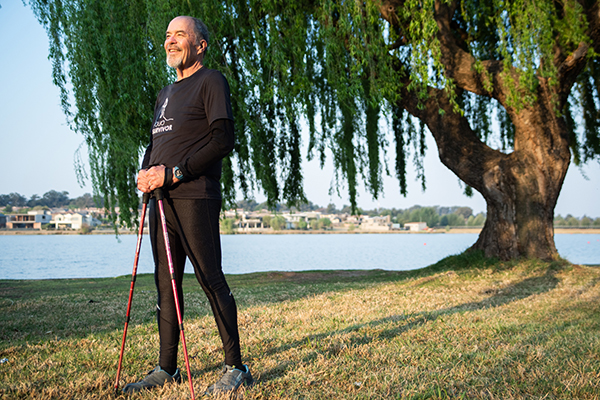
By Div Louw, Rotary Club of Benoni, South Africa
I was a typical, energetic four-year old in South Africa, running around our house with visions of my hero, long distance runner Jan Barnard, in my head when I felt something wrong. I ran inside and told my mother, “I have a dripping tap in my chest.” This was my way of describing what I felt, my heart skipping beats now and again. My mom, Christine, pressed an ear to my chest and called our general practitioner.
That would be the last day I would run imaginary races with Barnard. I had contracted spino-bulbar polio, which destroys neurons in the brainstem causing respiratory or cardiac failure. I was given less than a 2% chance of survival. This was in 1955, during a polio epidemic in South Africa, months before the Salk Vaccine was declared safe and effective.
I spent the next six months in isolation, staring at my parents through the window of an isolation ward. They would bring me beautiful presents, but I never got them. I thought the nurses had stolen them, and because I was paralyzed, I could not help myself. Later, I realized I had a room full of gifts back at home.
When I was discharged, the doctors were of the opinion I should undergo surgery, and that I should be put into casts and spend six months in recovery. They gave me very little chance of not being crippled. My Dad had a different opinion. He bought me a Fire Brigade (a bright red toy riding truck), and offered me a choice.
“Son, you can either go into the hospital and get leg calipers and hope you can be able to walk again or you can take this (toy truck) and do what you do best.”
That was the trigger for everything that followed. I loved that Fire Brigade. We became inseparable and it became my substitute legs. I eventually graduated to a bicycle and spent a lot of time getting up and dusting myself off. Then I learned to swim in the warm waters of a spa resort during family holidays, exuberantly applying my new-found unrestricted activity.
And something amazing happened. My broken body adapted. Nerves sprouted detours, surrounding muscles took over functionality of paralyzed ones. I almost looked and functioned normally. Almost.
It was at university when I dared train around other athletes that a passion rekindled to be a real athlete. I learned to play squash and joined some low-rated team rugby games. After college, I continued to play squash somewhat seriously.
But polio never really leaves you. During training for a league game, I once again became aware of my famous childhood foe. My heart skipped beats, I developed twitches and tremors. Once more in the Pretoria hospital, Professor Ben Lotz and his clinical assistant delivered dreadful news, the affects of polio had returned, I was suffering from what many know as postpolio syndrome. I was advised that I would soon be immobile, and my family was cautioned I may spend the rest of life in a wheelchair.
I did the only thing I knew how, I remained mobile and active.
In 2018, I saw a neurologist for a routine exam including an MRI and brain scan, and he once more expressed surprise that I was still walking. I took the news seriously, and prepared for possible immobility, shedding excess weight.
I started exercising. Walking. Then cycling. And finally, I returned to my favorite activity, swimming.
At the age of 70, I discovered para sport and became a triathlete. I was classified PTS-3 and after acquiring some regional medals, received gold in my category at the Africa Triathlon Championships in Sharm El Sheikh, Egypt, in 2021. I am now training to compete in Morocco at the championships 24-25 September, with a goal of under two hours to earn ranking for Paralympic participation.
I saw something in Egypt that moved me to want to advocate for these amazing para-athletes. They are responsible for every aspect of their own participation. They make all their own arrangements and cover all expenses, down to the last dime. They compete for the sake of the challenge, the thrill of achieving the impossible. While they could always use financial support, they deserve an accolade for their tenacity at the finish line.
I also knew I wanted to advocate for ending polio. But I knew I needed allies to do so. I searched the Internet and discovered that Rotary has been committed to eradicating polio for decades. Heeding the advice of a friend and member of the Rotary Club of Benoni, Annie Steijn, I attended a postpolio syndrome advocacy group. In July, I joined the club, and became one of its newest advocates for End Polio Now.
The intensity of my plea comes from experience. When I hear about resistance to vaccinations, and read about polio being detected in places including Europe, I want to tell people: Don’t let this happen to you. It must not. It cannot. Vaccines work. If I had a choice, I would have taken the vaccine.
The Rotary Club of Benoni and the District 9400 PolioPlus committee have started a Back-A-Buddy campaign to support my training with all proceeds going to Rotary’s PolioPlus Fund. See my Facebook page or contact grace@gracevanzyl.com for more information.


Nygren and Navajo Nation Council Delegate Otto Tso, who temporarily is overseeing the tribe's legislative branch, jointly announced the lifting of the mask mandate on social media Friday evening.
They cited figures from tribal health officials that show there's a low risk of transmission, based on the seven-day incidence rate of 51 cases per 100,000 people.
The number of positive cases overall during the pandemic still remains higher in the Navajo region than any other Indian Health Service region, except for Oklahoma. The Navajo Nation has tallied more than 2,000 COVID-related deaths since the pandemic began.
Nygren and Tso urged people to continue taking precautionary measures. Masks will still be required in schools, nursing homes and health care facilities, according to the latest public health order.
“It’s time for the Navajo people to get back to work,” Nygren said in a statement. “It’s time for them to be able to open their chapter houses to conduct local business and to receive services they are asking for and deserve.”
The news spread fast and comments poured in on social media. Some praised the action and others were sharply critical, including former President Jonathan Nez, who had sought a second term, and whose tenure was dominated by the response to the pandemic.
Nez credited the mask mandate for the lower coronavirus rates and said he's praying that COVID-19, RSV and flu cases don't rise.
“But the new administration needs to be held accountable if we see a surge in new infections, hospitalizations, and deaths,” he wrote on Twitter.
Enforcement of the mask mandate had been mixed on the 27,000 square-mile (69,000 square-kilometer) Navajo Nation. Most people wore masks at the inauguration for newly elected officials earlier this month, but neither Nygren or Nez kept one on the entire time.
Brian Parrish, who oversees the Navajo Nation Gaming Enterprise, said signage would be changed at the tribe's four casinos to indicate that masks now are optional. He said he suspected a large percentage of patrons haven’t returned because of the mask mandate but might now.
“We’re ready to take this next step toward getting back to normal,” he said late Friday.
Priscilla Todecheeny, who works at the Red Rock Trading Post in Red Valley, Arizona, said signs regarding masks came down once the reservation reopened to visitors, and no one was kept from entering. But she's concerned about employees who had been wearing masks.
“I think it should still be in stores for our safety because we don't know if another person might have the virus or is carrying it,” she said Friday.
Diana DeChilly, who is Navajo, was in the hospital Friday with the flu when she heard masks no longer were required on the reservation. She said she'd rather keep hers on to prevent the spread of any illness, even when she's discharged.
“I’m willing to bet a majority of Navajo people are going to keep wearing their masks, mandate or no mandate," she said.

Groundhog Day: Ancient Origins of a Modern Celebration

A groundhog emerges from its den in this photo by Minhaj, which was shared to Flickr with a Creative Commons License.
Most of us know the tradition: on February 2, our old friend the groundhog will emerge from hibernation, come out of his den, and predict whether winter will deliver more cold weather this year. If the groundhog sees his shadow, the story goes, he will return to hibernation and cold weather will persist another few weeks. If not, warm weather is around the corner.

This 1874 print from L. Prang & Co. calls the groundhog by its even more common name, “woodchuck,” and uses the older form of its scientific name, “Arctomys Monax.” The designation has since been changed to “Marmota Monax.” Find the archival scan with its bibliographic record here.
“Groundhog” is the common vernacular name of the ground squirrel formally known as Marmota Monax. This animal also goes by other names; the terms “woodchuck,” “marmot,” “land beaver,” “whistler,” and even “whistle-pig” all refer to the same creature. Whatever the name, there’s a strong belief that this little burrowing mammal predicts the weather, and a specific connection to the second day of February. This Groundhog Day tradition is celebrated in many places in the United States and Canada, with an emphasis on tongue-in-cheek humor and ceremonious proclamations. It is best known among people whose ancestors spoke German, especially the Pennsylvania Dutch.
If you like the folklore of holidays, you may be interested to know that Groundhog Day is related to two of the other holidays we have written about extensively on this blog: Halloween and Mayday. In his 2003 book Groundhog Day, folklorist Don Yoder traces the roots of Groundhog Day to the same cycle of pre-Christian festivals that gave us those two celebrations. In astronomical terms, these holidays were the cross-quarter days, those days that fall midway between a solstice and an equinox. These festivals were apparently celebrated throughout Europe by the various tribes we now refer to as Celts. Yoder believes that they influenced the sense of time of all Europe and of the European colonies in America:
The seasonal turning points in the Celtic year were immensely important communal festivals in prehistoric, pre-Christian times. Of these festivals, the dates have continued to be important down to the present time. […] The Celtic names for the four festivals were Samhain, Imbolc, Beltaine, and Lughnasa.
For the ancient Europeans, these days were so crucial and so embedded in their cultural sense of time that when the Western European peoples were Christianized, the new Church, unable to root them out, “baptized” them into Christian holidays. May 1 became May Day, originally associated with the Virgin Mary and later a secular spring festival, with maypole, May queen, and other folkloric customs. August 1 became in Britain Lammas, or “Loaf-Mass Day,” when the farmers’ wives brought the first loaves of bread baked from the new harvest of grain to the church to be blessed. Since November 1 in the Celtic year was a day devoted to the dead, the Church made it into All Saints’ Day. But the people continued to celebrate the eve of the old holiday as Halloween, with its many harmless folkloric customs that have come all the way down to our day. February 1, extended into February 2, became Candlemas, and eventually Groundhog Day.
All of these transitional days looked to the future, looked ahead to the next season, the coming three-month period, and hence were weather-important days.

This illustration of the courtship of the young warrior Cuchulain and the noblewoman Emer was created by Stephen Reid and published in 1909. The story of Cuchulain and Emer contains several clues to the importance of the festival called Oimel or Imbolc, one of the roots of Groundhog Day. The artwork is in the public domain.
In the Irish saga “The Wooing of Emer,” which probably dates to the 11th century but recounts events set in pre-Christian Ireland, we find that the four days named by Yoder were indeed the main reference points for the reckoning of time; to express the idea that her suitor must be such a skilled warrior that he is safe at all times, Emer says that he must be able to “go out in safety from Samhain to Oimel [Imbolc], from Oimel to Beltaine, and again from Beltaine to Bron Trogain [Lughnasa].” In the same story, the warrior Cuchulainn calls Imbolc “the beginning of Spring,” and opines that the name derives from an ancient word for sheep, because Imbolc “is the time when sheep come out and are milked.” This saga thus shows that Imbolc was considered a seasonal turning point and a marker of time, and connected with the agrarian year and particularly with animal husbandry.
Unfortunately, we don’t know that much else about how ancient Celts celebrated Imbolc, but its importance as the first day of spring persisted to living memory. In Ireland, where most of our information about the holiday comes from, The Encyclopedia of Irish Spirituality tells us:
The day remains an agricultural festival. Farmers expect good weather for planting on Imbolc and fishermen traditionally overhauled their boats on this day. In traditional practice, there is divination to foretell the weather and family fortunes in the coming year.
Of course, Imbolc now goes by many names. In the Christian calendar, it became feast of the Purification of the Virgin Mary and the Presentation of Christ in the Temple, and in the Irish church in particular it is celebrated as St. Brigid’s Day. It is traditionally a day when people brought their candles to church to be blessed, so in English vernacular tradition, it is Candlemas, and in French and Spanish it’s known as Chandeleur and Candelaria. But the tradition of predicting the weather persisted through many of the holiday’s variations.

The 2011 photo “Groundhog & Peach” by “Steve 1828” was shared to Flickr with a creative commons license.
Versions of this Candlemas weather-lore in English, Scots, and Latin have been preserved both as simple statements of belief and practice, and as rhymes, a few of which are listed in the Oxford Dictionary of Proverbs:
Men were wonte for to discerne
By candlemas day what wedder shulde holde.
(John Skelton, 1523)If Maries purifieng daie,
Be cleare and bright with sunnie raie,
The frost and cold shal be much more,
After the feast than was before.
(Reginald Scot, 1584)If Candlemas day be fair and bright
Winter will have another flight
If on Candlemas day it be showre and rain
Winter is gone and will not come again.
(John Ray, 1678)Si Sol splendescat Maria purificante
Major erit glacies post festum quam fuit ante.
(John Ray, 1678)

The cover of Don Yoder’s book Groundhog Day shows Bill Deeley of the Inner Circle holding up the groundhog weather prophet Punxsutawney Phil during the 2002 Groundhog Day ceremony in Punxsutawney, Pennsylvania.
Weather prognostication, then, became associated with the beginning of February during ancient times, and the tradition persists until today. But this still leaves us in the dark as to the groundhog and his role in the process!
It seems this part of the tradition, too, comes from Europe. Specifically, it comes from parts of Europe that were Celtic in ancient times, but were later inhabited by Germanic speakers. Germans believed the weather was predicted by a badger rather than a groundhog, but the traditions are otherwise almost identical. Yoder explains:
The Handwörterbuch des Deutschen Aberglaubens, or the Dictionary of German Folk Belief, has an article on Lichtmess, or Candlemas. “Above all,” it says, “Candlemas is decisive for the weather of the coming time, and with it also for the fruitfulness of the year.” […] This European encyclopedia also cites the Dachs, or badger, as the Candlemas weather prophet throughout much of German-speaking Europe…. Dachstag, or Badger Day, is a German folk expression for Candlemas. The belief was […] if the badger encountered sunshine on Candlemas and therefore saw his shadow, he crawled back into his hole to stay for four more weeks, which would be a continuation of winter weather.
As Yoder also points out, the badger is like the groundhog in being a small, hibernating, forest-dwelling mammal known for being very shy, and it was only natural for German-speaking immigrants to America to substitute the groundhog for the badger.
The first mention Yoder has found of groundhogs predicting the weather on February 2 is in a diary entry for that day in 1840, written by a Welsh-American storekeeper in Pennsylvania:
Today the Germans say the groundhog comes out of his winter quarters and if he sees his shadow he returns in and remains there 40 days.
Morris describes this as a general belief of his German neighbors; it doesn’t appear to be limited to a single family or town, nor does he seem to think it is a brand-new belief. Since the belief and practice almost certainly came from Europe, and since the bulk of Pennsylvania Dutch immigration occurred between 1727 and 1775, it’s likely Groundhog Day was born in that period.
The beliefs and practices of Groundhog Day have led to a fascinating development in Pennsylvania Dutch country: the “Groundhog Lodges,” a loose organization of social clubs focused on the maintenance of Pennsylvania Dutch language and culture. The lodges, which hold meetings called “versammlinge,” at which participants speak only Pennsylvania Dutch, have existed since the 1930s. In his 2016 book Serious Nonsense, William W. Donner describes his first versammling in the 1990s:

The cover of William W. Donner’s book Serious Nonsense shows a meeting of Groundhog Lodge #1 in 1971, with an eight foot tall statue of a Groundhog wearing a crown being wheeled down the aisle.
There were three or four hundred men in the hall. At the front were a decorated stage and an eight-foot statue of a groundhog wearing a crown. At the beginning of the meeting, everyone stood reverently as men in top hats carried in a stuffed groundhog and placed it in front of the speaker’s podium. They pledged allegiance to the American flag, sang “America,” and then listened to a prayer, all in the Pennsylvania German Deitsch language. They raised both hands as paws and took an oath of allegiance to the lodge and groundhog; they listened to a weather report, piped into the speaker system, about whether or not the groundhog saw his shadow; they ate a hearty meal; they sang songs; they watched a humorous skit about a lecherous doctor who cured people by transferring their ailments to his assistant; and they listened to an inspirational talk, sprinkled with humor, about the values of Pennsylvania German life. Anyone who spoke English, especially from the podium, was charged a fine for each word.
There is much more information about the lodges and their activities in Donner’s book, if you want to seek out a versammling for a Pennsylvania German experience. (I’ll mention here that “Pennsylvania Dutch” and “Pennsylvania German” mean the same thing; Don Yoder preferred the former term and William Donner prefers the latter.)
If you’re not Pennsylvania Dutch OR Pennsylvania German, you may feel like celebrating Groundhog Day without attending a long meeting or paying a fine for speaking English. One option, of course, is to attend a Groundhog Day celebration. Because of their association with a hibernating woodchuck, many such events are held outdoors, so you won’t be in a large indoor gathering, but we still urge you to take pandemic precautions and wear a mask!
The best known Groundhog Day ceremony occurs each year in Punxsutawney, Pennsylvania. This annual festival traces its origin to 1887, when members of the local Elks Lodge first went to nearby Gobbler’s Knob to consult a groundhog about the weather. The observance developed into an annual tongue-in-cheek ceremony at which the groundhog, given the name “Punxsutawney Phil” in the 1960s, communicates his prediction to the “Inner Circle,” a group of men wearing formal suits and top hats. Though it’s only one of many Groundhog Day ceremonies held all across the United States and Canada, the Punxsutawney event is certainly the most popular, especially since it became the basis of the renowned philosophical comedy film Groundhog Day, which the Library of Congress inducted into the National Film Registry in 2015. (You can read its induction essay in a pdf at this link.)

This photo of the Groundhog Day sign in Punxsutawney, Pennsylvania, was taken by Aaron Silvers and shared to Flickr with a Creative Commons License.
If you live near us in Washington, D.C., you may be happy to know that we have our own local Groundhog Day observance at the Dupont Circle Fountain. Modeled on the Punxsutawney event, ours features “Potomac Phil,” a stuffed groundhog who magically communicates his predictions to an Inner Circle of people in top hats. Unlike his Punxsutawney relative, Potomac Phil makes predictions about both the physical and the political climate. In 2021, for example, he predicted both an early Spring and continued political gridlock. We’ll let you judge how accurate he was!
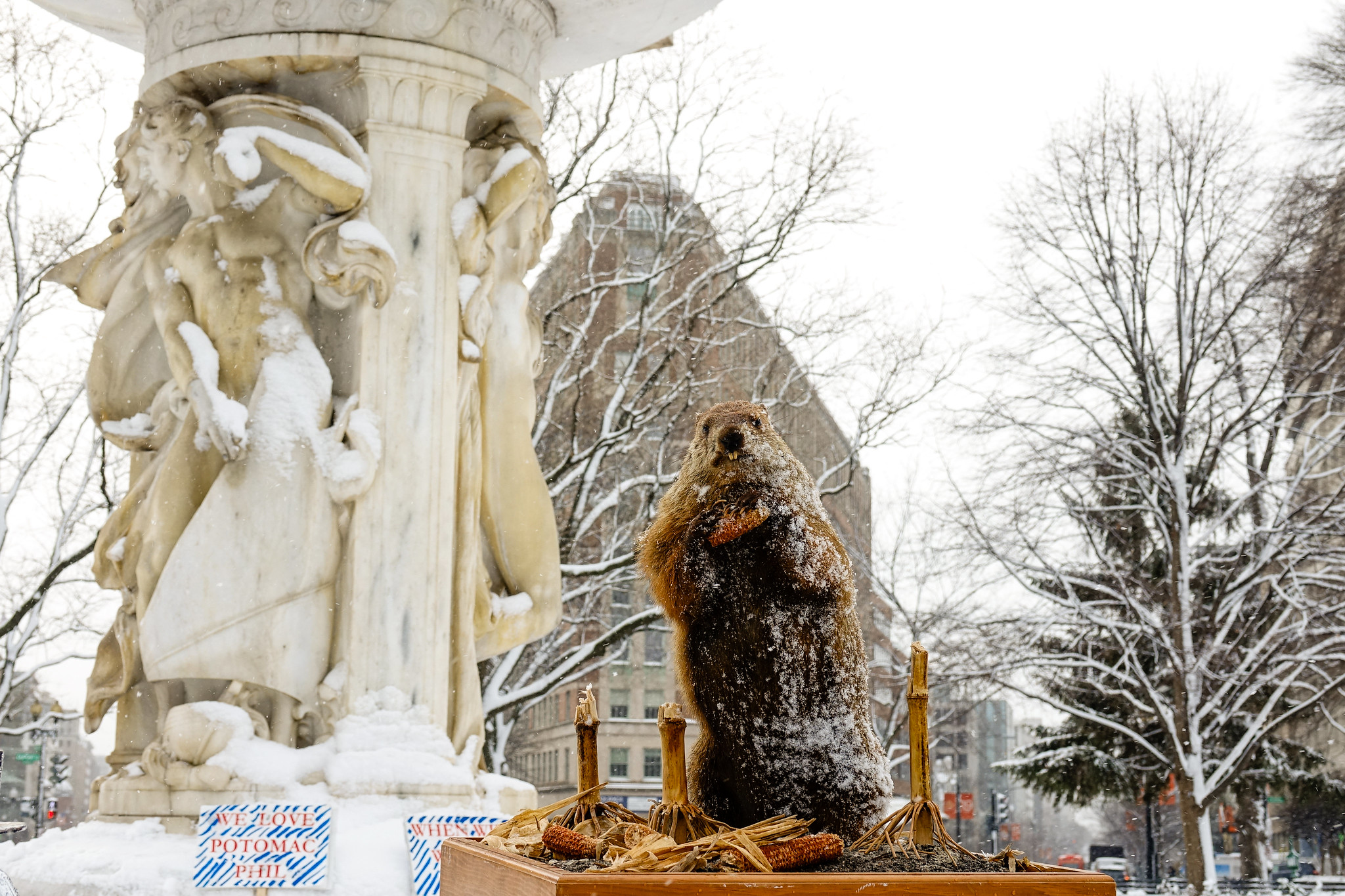
“Potomac Phil” holds court in Dupont Circle in this photo from Groundhog Day 2021. The photo was taken by “angela n.” and shared to Flickr with a Creative Commons License.
Potomac Phil’s tradition continues in 2022. As the Dupont Festival promises:
WED, FEB 2, 2022 at 8:30AM sharp – GROUNDHOG DAY: Potomac Phil, the National Groundhog, will make an appearance and offer weather and political predictions. Phil will let us know whether to expect six more weeks of winter or an early spring. Music, polka dancers, puppet show, lots of coffee, VIP celebrities and more.
Of course, if you don’t live near a Groundhog Day ceremony, and you don’t want to travel, you can always watch the film Groundhog Day! Or you can read the two books I’ve mentioned, Don Yoder’s Groundhog Day and William W. Donner’s Serious Nonsense. If you have kids (or are a kid), there are a lot of children’s books about Groundhog Day at the Library, which you can learn about at this link.

Potomac Phil whispers predictions to one of his Inner Circle of followers in this photo from Groundhog Day 2017 in Dupont Circle. The photo was taken by Joe Flood and shared to Flickr with a Creative Commons license.
If you’re feeling very committed, you can cook and eat a groundhog; recipes were printed in many early American cookbooks such as this one, and even Irma Rombauer’s classic Joy of Cooking contained instructions for cooking “woodchuck” (which is just another name for “groundhog”) through the 1970s. Mind you, I’m not recommending eating a groundhog, just pointing out it’s possible, so I won’t include any recipes here!

The Library of Congress has an edition of this book of Groundhog Day carols.
Another way to celebrate–and one we particularly recommend–is to sing or listen to groundhog songs. Yoder’s book contains parodies of carols such as “Grundsow Ivver Alles,” sung to the well-known German anthem; “Today the Groundhog Comes,” sung to “John Brown’s Body;” and “Punxsutawney Phil Looked Out,” sung to the tune of “Good King Wenceslas.” The Library of Congress even has a whole book of Groundhog Day carols, which you can learn about at this link.
While these song parodies constitute a vibrant tradition in their own right, the American Folklife Center’s archive can offer some older and less self-conscious groundhog songs. In particular, we have two available online: the well-known fiddle tune and banjo song just called “Groundhog,” and a blues song called “Prowling Groundhog.”
“Prowling Groundhog,” in various versions, has been part of the blues repertoire since the 1930s, but the version AFC has online in our collections was recorded in the 1970s from Sam Chatmon. It’s online at this link, at the website of our colleagues at the Association for Cultural Equity.
Groundhog Day has variations that are celebrated in other parts of the world. Take a look:
| Country | Holiday | Occasion | Date |
|---|---|---|---|
| Alaska | Marmot Day | There are no groundhogs in Alaska, but there are marmots! | February 2 |
| Serbia | Sretenje | On ‘The Meeting of the Lord,’ it is believed that the bear will awaken from hibernation. | February 15 |
| Germany | Siebenschläfertag | Meaning ‘Seven Sleepers Day,’ if it is rainy, it means the rest of the season will have lots of rain. | June 27 |
| Scotland | Imbolc | This is a Gaelic traditional festival marking the beginning of spring. | February 1 |
weekly@StateOfJeffersonRotary.org

Your Guide to Conquering the Caffeine Crash
For better or worse, many of us run on caffeine on a daily basis. Rather than pay the price in the afternoon, or in sleepless nights, try tips and tricks to handle the caffeine crash.
Caffeine can make you feel on top of the world, allowing you to perform at your peak. Yet, for many of us, it comes with a steep price.
As its effects start to wear off, usually in the afternoon, that on-top-of-the-world feeling can transform into a “do I still have a brain?” sentiment. Caffeine can also interfere with sleep, which leads to a vicious cycle of drink coffee, can’t sleep, drink even more coffee, repeat.
Finally, when some of us go too long between doses, we experience intense withdrawal symptoms. Think headache, lethargy, and the feeling as if your brain has been replaced by static electricity. These symptoms can start kicking in within 16 hours of your last dose, according to a 2010 study on 379 people.
(By the way: When caffeine addicts drink coffee, they may not experience a true energy boost, but rather a reduction of our withdrawal symptoms. This is why caffeine studies require coffee abstinence for a week or more).
If you’re sick of the downsides, know this: There’s another way, and it doesn’t necessarily involve splitting up with caffeine for good. Before learning the remedy, however, you’ll need a quick lesson in neurochemistry.
The Wake Up and the Crash
Many people think of coffee beans when they think of caffeine, but the stimulant is actually found in at least 60 different plants, where it functions as a natural pesticide. When ingested by humans, caffeine improves physical endurance and strength, and enhances memory, attention, and mood.
To understand why caffeine gives us such a boost, imagine a parking lot with a limited number of spaces, says Nanci Guest, a caffeine researcher at University of Toronto and lead author on the International Society of Sports Nutrition’s formal position on caffeine and exercise performance.
More About Coffee:
-
According to recent research, coffee can be good for you.
-
What defines our reaction to caffeine? Our intake habits and genetic makeup seem to be the most influential factors.
-
Different cultures consume coffee in different ways.
When caffeine floods your brain, it parks in spaces (technically called receptors) usually reserved for adenosine, a brain molecule that makes you feel sleepy. When caffeine hogs up all the spaces, adenosine can’t park. So it circles the lot. In addition to preventing adenosine from communicating the “calm, relaxed, let’s maybe take a nap” signal, caffeine also triggers the release of other alertness-producing brain chemicals like norepinephrine and dopamine, among others.
But this effect has a time limit; around lunch or midday, you might experience a letdown. That’s because in the morning, there aren’t that many adenosine molecules circulating since your brain cleared them while you were sleeping. As the day wears on, however, more and more of them show up in search of a parking space. At the same time, the caffeine cars start to call it quits and vacate the receptor spaces. As more adenosine cars park and more caffeine cars leave, you’ll start to feel groggy.
How to Avoid a Caffeine Crash
Not everyone experiences withdrawal symptoms, says Guest.
If you’re one of those genetically gifted people who can take or leave caffeine, then consider skipping it in the morning. Instead, only have caffeine when you feel tired. By delivering the stimulant only as needed, you increase its effectiveness, according to Guest.
For people who experience intense withdrawal, however, here’s another strategy: When you wake, consume less caffeine than you think you need. The right dose of caffeine can improve performance. Drink too much, however, and you’ll likely feel “on,” but actually struggle to concentrate. That’s because you’re overstimulated, which makes you restless, anxious, and unfocused. “When you’re at your desk and you have too much physical energy, it can be distracting,” Guest says.
Read more: Why Caffeine Affects People Differently
As far as finding the best dose, you’ll likely need to experiment to find your personal sweet spot. Aim for something in the neighborhood of 1 to 2 milligrams of caffeine per each kilogram of body weight. To simplify that conversion (especially for those who haven’t yet had their caffeine today), here’s the math for several body weights and the proportional amount of caffeine below:

Depending on your body weight and whether you’re aiming for the low (1 mg) or high (2 mg) end, you’re looking at somewhere between 45 mg (a cup of black tea) and 200-250 mg (16 ounces of brewed coffee) of caffeine.
If you usually have a lot more than that, consider cutting back a tad rather than drastically altering your intake. That way, you’ll avoid those dreaded withdrawal symptoms. For example, if you usually have a large coffee drink, consider getting the medium. If you usually ask for three shots, try two, says Guest.
Try This In the Afternoon
The great news is, if you get your morning coffee dose just right, you might not experience a crash in the afternoon. That said, it’s also possible that, as the caffeine wears off, you’ll start to feel groggy.
For a pick-me-up, consider a small caffeine hit. (Note emphasis on “small.”) Consume too much caffeine too late in the day and you’ll likely sleep fitfully that night, setting up that vicious cycle mentioned above. For the best results:
-
Stop drinking caffeine at least 8 to 12 hours before your usual bedtime.
-
Have about half as much caffeine as you did in the morning.
-
Know that the caffeine content of coffee drinks can vary a lot. Even at the same coffee shop, the amount of caffeine in a small coffee is sometimes double one day what it was the previous day, says Guest. For this reason, a caffeine capsule (such as half of a 100-mg Wake Ups tablet) might be the better way to go.
Do This in the Evening
Some people swear that they can drink a cup of coffee at 10 p.m. and fall asleep 10 minutes later. If you’re one of them, know that your sleep quality is likely suffering, and you may not even be aware of it.
In a 2021 study that monitored brain activity in participants during sleep, caffeine ingestion seemed to prevent deeper, more restorative sleep. Without this deep sleep, your brain doesn’t thoroughly recover overnight, which sets you up for what some people call “the caffeine and sleep sandwich.” The following day, you struggle to feel alert, which leads to more caffeine which leads to worse sleep and the cycle continues.
To achieve the glorious state of all-day energy, you’ll most likely need to finagle with the above advice. That’s because your genetics will affect your results, says Guest. Keep a journal for a few weeks, taking note of your energy levels, sleep habits and caffeine dose. Eventually, with some experimentation and iteration, you’ll find a “personalized caffeine regimen” that works best for you personally.
You are not authorised to post comments.