
  |
|
December 1, 2022 |
 With the traditional ringing of the bell we bring this meeting to order!
Club member's attendance is recorded by logging in.
Visiting Rotarians may complete a makeup form at the end of this meeting; YOUR donation for making up with us helps fund our service projects!
Visitors are always welcome to browse and register without obligation.
Our club offers the flexibility of ROTARY ON YOUR TIME!
and an opportunity to remain connected with Rotary!

Welcome to this week’s meeting of the eClub of the State of Jefferson.
I am Bob Gibson, President of the Rotary eClub of State of Jefferson. Welcome to this week’s meeting. I hope this finds you well.
As we move deeper into the Holiday season there will be many gatherings of friends and families. Many Rotary clubs schedule parties and social functions. While our digital format limits our face-to-face functions, the importance and value of the friendships and acquaintances developed in our Club is just as important. Sometimes it is good to remind ourselves that Paul Harris started the regular meetings to satisfy a need for fellowship. Your Board is working to create more opportunities for interaction. I believe there is a strong correlation between the strength of our relationships and our ability to provide service.
Also, mark Saturday, December 10 at 9:00AM Pacific Standard Time on your calendar. We will have member Zoom meeting to vote on the proposed Bylaws and a slate of officers and Board members. It will put us on schedule for these important decisions.
I am very thankful for our Rotary Club and all of you. Your work and support exemplifies the best of Rotary. If you celebrate this U. S. holiday, have a Happy Thanksgiving.
Thank you for your interest in our Club and your commitment to “Service above Self.”
Enjoy the meeting.
If you have any questions or comments, I am available. My e-mail address is: bob@bluewaterphoto.net.
email president@StateOfJeffersonRotary.org

Saturday, December 10 at 9:00 A.M. (PST)
Member Zoom meeting
to vote on the slate of officers and Board members and proposed Bylaws.
December is Disease Prevention and Treatment Month

We believe good health care is everyone’s right. Yet 400 million people in the world can’t afford or don’t have access to basic health care.
Disease results in misery, pain, and poverty for millions of people worldwide. That’s why treating and preventing disease is so important to us. We lead efforts both large and small. We set up temporary clinics, blood donation centers, and training facilities in underserved communities struggling with outbreaks and health care access. We design and build infrastructure that allows doctors, patients, and governments to work together.
Our members combat diseases like malaria, HIV/AIDS, Alzheimer’s, multiple sclerosis, diabetes, and polio. Prevention is important, which is why we also focus on health education and bringing people routine hearing, vision, and dental care.
How Rotary makes help happen
We educate and equip communities to stop the spread of life-threatening diseases. Rotary members have hundreds of health projects underway around the world at any given time.


Rotary Peace Fellowships impact thousands
By Alejandra Rueda, 2008-10 Rotary Peace Fellow, University of Berkeley
 When I became a Rotary Peace Fellow in 2008, the presidential theme was Make Dreams Real. My dream was to support the Colombian countryside by improving the quality of life of farmers and, in turn, to achieve a more responsible use of nature and the ecosystem services it provides. I also wanted to help resolve the social conflict that Colombia has experienced. Or at the very least, to contribute to the development of projects that would spur economic and social recovery in areas that sorely needed it.
I was already envisioning a new professional focus in my life, through my pursuit of a master’s degree in Energy and Resources from the University of California, Berkeley. But coupled with the Peace and Conflict Resolution program, I was touched by a totally exciting new topic: sustainability. I knew that sustainable practices would be needed across the globe. As a peace fellow, I learned valuable tools to have an impact and make a difference in diverse communities.
During the last decade, I have been able to interact with hundreds, if not thousands, of farmers in Latin America. Nearly 4,500 farmers have been impacted by the programs that we, at NES Naturaleza, have developed. The Rotary Peace Fellowship started a chain of positive impacts. A chain of light which we have been able to continue and bring to the farmers.
Rural people have gained access to knowledge and been trained in sustainable practices in very remote areas of Latin America. Some of them have already been certified in existing sustainable standards. Unmistakably, without the Rotary Peace Centers program, this would not have been possible.
The knowledge I gained, I was able to spread to thousands of people. Farmers who in turn conveyed it to their relatives. Entire families were impacted. Thanks to Rotary and my experience through the peace fellows program, many of these farmers are now entrepreneurs. Those who did not know very well their markets or their potential, now have a completely different vision, not only of their farm as a business, but also of the surrounding natural ecosystems that complement them.
Nevertheless, there is still work to do.
This year’s presidential theme, Imagine Rotary, returns us to a spirit of dreaming and doing. We are being invited to act for a better and more sustainable world where the pillars of sustainability become the philosophy that drives each one of us.
Our planet can no longer wait. We have seen it, we have heard it, and we have lived it. We know the United Nations Sustainable Development Goals. But in our daily lives, we have not yet appropriated them. It would be great to go back to basics. By knowing the definitions of social, environmental, and economic responsibility, we will clearly understand what they entail.
Imagine Rotary is imagining our world because Rotary is in every corner of our planet. Rotary embodies thousands of people always committed to giving something more. Thousands of people who, through Rotary Foundation programs like the Rotary Peace Fellowship, have positively impacted the lives of thousands of others. It is this chain of positive impacts that shines brightly every time someone in the community dreams and acts and connects to someone else.
For this and much more, I thank you Rotary.
No Borders Rotaract

No Borders Rotaract is the eClub's sponsored Rotaract club, founded in 2015, No Borders is a Global Rotaract club. Visit their website to see what a great job they are doing.
The No Borders Rotaract brings together young professionals from across the world to exchange ideas, develop leadership and professional skills, and have fun through service.
As an online global service club you can live anywhere and still be an active member of No Borders. We have two online meetings each month that focus on leadership, professional development skills, life hacks, updates on global humanitarian efforts, and advancements through Rotary. We also work together on projects in our local communities and abroad.
Meet the No Borders club officers
President
 Name: Zoe Hershenson
Vocation: Freelance Writer and Proofreader
Home Country: United States of America
Vice President I President-Elect
 Name: Aishwarya Saxena
Vocation: Education
Home Country: India
Secretary
 Name: Anja Jungmayr
Vocation: Environmentalism
Home Country: Austria
Treasurer
 Name: Sierra Mayer
Vocation: Teaching & Art
Home Country: United States of America
Member at Large
 Name: Anshuman Nayak (Moon)
Vocation: Defense R&D, Government of India
Home Country: India
Immediate Past President
Name: Karl Uzcategui
Vocation: Higher Education Administration
Home Country: United States of America

Thanks to eClub Rotarian Carol F. for suggesting this article.
Polio Update
WHO Allows nOPV2 for cVDPV2
Let's unpack that. Last week, the World Health Organization issued a recommendation that will allow rollout of a new oral vaccine, Novel Oral Polio Vaccine type 2 (nOPV2). This vaccine will be available for limited use in countries affected by outbreaks of circulating vaccine-derived poliovirus type 2 (cVDPV2).
We can unpack it a bit more: of the three strains of wild polio virus, only type 2 has never been eradicated (is "endemic") in Pakistan and Afghanistan. The oral vaccine that has been used for a long time to protect against type 2 is live, and can mutate and spread (circulate) to unvaccinated children. The new (novel) vaccine is more stable, less likely to mutate and very unlikely to circulate to unvaccinated children. This means it is preferred in regions where vaccination rates, for cultural or logistical reasons, are low.
If you want to hear someone else repeat what you just read, here's a nice animation: Oral Polio Vaccine Type 2 animation
Officials Rename Popular Grand Canyon Site to Honor Havasupai Tribe
The National Park Service forcibly removed members of the tribe from the area in the 1920s

Visitors to Grand Canyon National Park’s popular Bright Angel Trail will soon find that a popular landmark has been renamed: An area once called “Indian Garden” will become “Havasupai Gardens.”
Nearly 100 years ago, the National Park Service (NPS) forcibly removed members of the Havasupai Tribe from the inner rim of the Grand Canyon. The tribe, which now resides on a nearby reservation, passed a resolution earlier this year to formally request the name change. (In the Havasupai language, the area known as “Indian Garden” was originally called “Ha’a Gyoh.”)
“Every year, approximately 100,000 people visit the area while hiking the Bright Angel Trail, largely unaware of this history,” says tribe chairman Thomas Siyuja Sr. in a statement from the NPS. “The renaming of this sacred place to Havasupai Gardens will finally right that wrong.”
The last known resident of the area was a Havasupai man known as “Captain Burro.” The NPS forcibly removed him in 1928. The lands he and his family used to walk and farm are now part of the park’s most popular hiking trails.
The Burro family later changed its name to Tilousi, which means “storyteller.” Carletta Tilousi, a former Tribal Council member, is a descendant of the family.
 “I am glad to see that we will always remember and honor the true history of my family’s forced relocation due to the development of the Grand Canyon National Park,” says Tilousi in the NPS statement. “For that reason, honoring our ancestors and remembering our history is also very important to the Havasupai people. I hope this historic action will help other Tribes take similar steps and reclaim lands back by changing place names for historic and cultural preservation purposes.”
The name change is only the latest example of a larger effort to change the names of destinations that are offensive to Native Americans. Just a few months ago, for example, hundreds of federal sites across the country officially changed their names to remove a racial slur.
The NPS and the Havasupai Tribe are collaborating on a rededication ceremony, which will take place in the spring. In the meantime, staff will begin swapping out signs around the park as soon as possible.
“The Grand Canyon National Park team was proud to work alongside the Havasupai Tribal Council in our joint effort to rename this culturally significant location at the Grand Canyon,” says Ed Keable, the park superintendent, in the NPS statement. “The Havasupai people have actively occupied this area since time immemorial, before the land’s designation as a National Park and until the park forcibly removed them in 1926. This renaming is long overdue. It is a measure of respect for the undue hardship imposed by the park on the Havasupai people.”

Meet Ada Lovelace, The First Computer Programmer
Though Lovelace was excluded from higher education, her mathematical contributions form the foundations of computer science.

Ada Byron was on her best behavior when first presented to the British Royal Court — though she found the event and its attendees to be underwhelming. A few weeks later, however, the 17-year-old accompanied her mother to a mathematics lecture. That event captured her imagination and changed her life.
Within the next decade, she married and became Ada King, Countess of Lovelace. But historians remember her as Ada Lovelace, a computer science pioneer whose contributions in the early 1840s provided mathematicians and inventors with the foundation needed to advance computing technologies.
As a woman, Lovelace was barred from formal study and relied on tutors and mentors to develop her skills. Her legacy has also been subject to misogyny, as some historians have challenged her abilities and claimed Lovelace didn’t possess the mathematical prowess she claimed. In recent years, however, new insight from her writings has found that Lovelace indeed deserves her spot in history.
Super Computer
The lecture that inspired Lovelace was given by mathematician and inventor Charles Babbage. He had invented the Difference Engine, a type of calculator meant to take a specific formula and compute successive values. Babbage was also working on the Analytic Engine, which he hoped would be a general-purpose calculator that could vary the type of formulas it computed.
For Lovelace, it was mind-blowing to think that mathematicians could design a machine that crunched numbers on demand. She subsequently began a friendship and correspondence with Babbage that lasted for almost two decades.
In 1843, Lovelace published a paper of her own on Babbage’s Analytical Engine. Her work translated another scholar’s article from French to English, though she added appendices that were double the length of the original work. These appendices consisted of a table of mathematical entries, and they were meant to show how the computer might function.
The tables served as a building block for the mathematicians and inventors who later took the idea of a computer from paper to actuality. Yet others claimed she wasn’t their true author and that she didn’t deserve credit at all.
Questionable Math
These detractors claimed Lovelace was merely a student of Babbage, and that her relationship with him was that of a mentor and student — rather than a meeting of minds. The criticism has prompted some to argue that Lovelace simply regurgitated pieces of Babbage’s earlier works.
Others have used her exclusion from academia against her. As a woman, Lovelace was barred from studying in higher education; she followed a traditional method of mathematics study that failed to include algebra as part of trigonometry. Lovelace did, however, pursue study into algebra and advanced calculus on her own terms. Augustus De Morgan, the famed mathematician and logician, personally tutored her.
It appears that Lovelace’s social status meant she knew all the right people, in all the right places. But for more than two centuries, one connection in particular has almost overshadowed her legacy as a computing pioneer.
The Poet’s Daughter
Lovelace was born on December 1815 to poet Lord George Gordon Bryon, the most famous poet in England at the time — and known just as well for his many affairs. One of the most scandalous rumors surrounding Lovelace’s father alleged an incestuous romance with his older half-sister.
Lovelace’s parents separated within a month of her birth — a scandal that drove her father to leave England for France. Lovelace never met Lord Byron; he died in 1824 from a fever at the age of 36. Her mother, however, got along just fine without a husband.
Lady Annabella Bryon came from a wealthy family, whose patriarch was a member of Parliament. Because Lady Byron did not want her daughter to grow up to be a poet like Lord Byron, the family used their resources to instead hire tutors in math and science. Attending mathematics lectures and building lifelong friendships with scientists and scholars helped Lovelace gain valuable access to one-on-one instruction and mentoring in the field.
Her contributions to computing might have been even greater, had she not ailed from uterine cancer for more than 18 months before dying at the age of 36 in November 1852. Her letters and writings have been preserved over the years and prompt historians to question what else the world’s first computer programmer might have accomplished had she lived longer.
weekly@StateOfJeffersonRotary.org

The Correct Way to Hang Toilet Paper: Over or Under?
By Brandon Specktor
Does toilet paper go over or under? We finally have the answer.
It’s an argument every persnickety homeowner has had: Should the end of the toilet paper hang over the top of the roll or be tucked underneath it? We may finally have an answer to whether toilet paper goes over or under, courtesy of an 1891 patent by New York businessman Seth Wheeler.
Credited by some as America’s founding father of toilet paper, Wheeler patented the first perforated wipes in 1871 and launched his Albany Perforated Wrapping Paper Company in ’77, two years before the Scott brothers debuted their blockbuster brand. Wheeler filed dozens of patents until the 1920s, including those for toilet paper crimped into ornamental patterns and disposable “bosom pads” meant to replace expensive corsets. But his greatest invention was the roll-and-handles design in 1891—a now-ubiquitous fixture whose patent illustration solved the toilet paper over or under issue before it even started. Take a look:
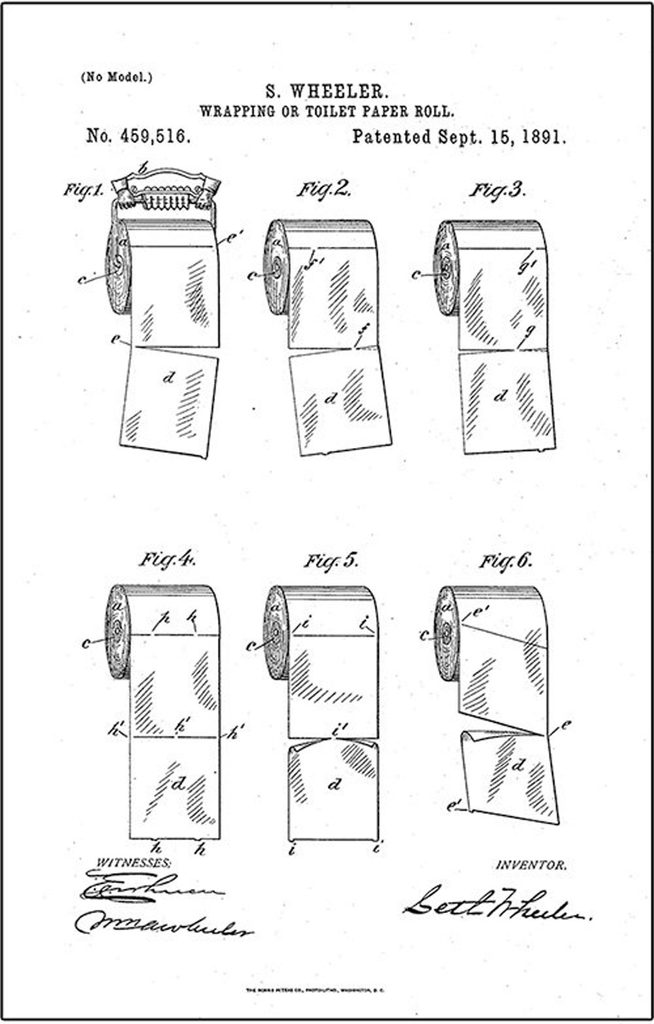 Photo: Courtesy of Seth Wheeler
The answer, as you can see above, is “over”—no surprise to the estimated 70 percent of wipers who already prefer this position, according to cnet.com. Proponents say an “over” roll provides easier access to the free end of the toilet paper and minimizes the risk of knuckle-on-bathroom-wall germ gathering.
The vehement 30 percent in the “under” camp counter that their position gives a tidier appearance and makes paper less prone to pet attacks—concerns that Victorian homeowners probably overlooked after switching from aloe-infused hemp sheets to Wheeler’s first perforated rolls.
Now that you know how to hang your roll, are you using the right toilet paper for your plumbing? Some toilet paper alternatives are sure to cause clogs.
You are not authorised to post comments.